Guides · Fortunest facts reviewed 8 September 2026
Fortunest vs Snowball Analytics: which portfolio tracker fits you in 2026
Snowball Analytics is a dividend tracker with a wide front door: brokerage connections to over a thousand institutions, a dividend calendar and rating, public portfolios to browse, and prices in dollars. Fortunest is a European engine: broker exports and exchange keys rebuilt into a daily-rate history, risk and tax analysis, and an AI assistant on the free plan that reads the actual portfolio, income side included — it explains any metric on your own numbers, reads the dividends card and the events calendar back to you, looks up any company's quote, news, next earnings and dividend dates and the results filing behind them, writes an earnings-season digest weighted by position size, and on Pro publishes an MCP server that Claude Code, Codex or any MCP-capable agent can drive. Pick Snowball if you live off dividends; pick Fortunest if you want the whole picture for €69 a year.
The short answer
- Pick Fortunest if your portfolio is European and mixed: 29 broker CSV and Excel exports detected automatically, read-only API keys for Kraken, Binance, Coinbase and Interactive Brokers, every day of history converted at that day's rate into any display currency, TWR and IRR with volatility, Sharpe, Sortino, beta and drawdowns, tax lots on Pro, and an assistant that reads your holdings and the live screen — explaining any metric on your own numbers, dividends and income included, filtering the table from a sentence, looking up any company's quote, news, next earnings and dividend dates and the SEC filing behind them, and adding an asset you describe or screenshot. Free without an account; €69 a year for Pro, which also opens the same tools to Claude Code, Codex or any MCP-capable agent.
- Pick Snowball Analytics if dividends are the point: a dividend calendar, dividend growth, a rating built on a company's earnings, yield and payout ratio, a reinvestment calculator, custom withholding tax on every plan, automatic connections to over a thousand brokers synced nightly, public and model portfolios to compare against, and native phone apps. Paid plans start at US$79.99 a year.
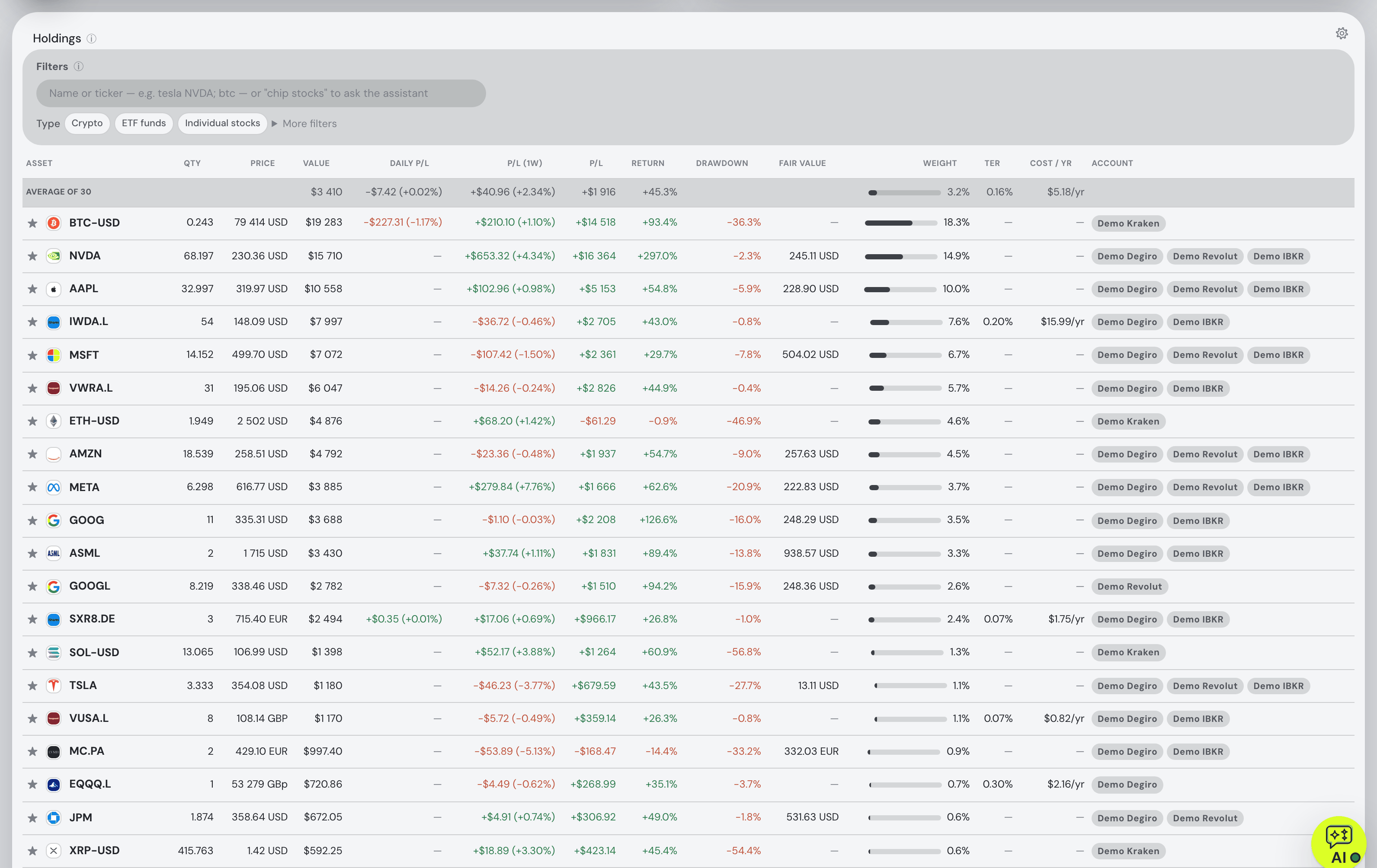
The comparison
Each cell is what the vendor's own pages say, in the vendor's terms, on the date in the footnote. Not described means the page does not mention it — a statement about the page, not about the product. A green ✓ marks whichever product leads a row on that row's own terms; four of the twelve rows below go to Snowball.
| Fortunest1 | Snowball Analytics2 | |
|---|---|---|
| Runs on |
|
|
| Account required |
|
|
| Free plan |
|
|
| Paid from |
|
|
| Broker imports for EU investors |
|
|
| Currencies |
|
|
| Returns & risk |
|
|
| Dividends |
|
|
| Tax |
|
|
| AI assistant |
|
|
| Sharing & community |
|
|
| Where your data lives |
|
|
Snowball's cells were checked on its own pricing, product and dividend-tracker pages on 7 September 2026; quotations are its wording. Fortunest's cells come from its documentation. Neither product is open source. Prices are list prices before promotions — Snowball's in US dollars, Fortunest's in euros and before VAT — and both products ship continuously.
When to pick which
These two overlap less than the category suggests: one is built around an income stream, the other around a mixed European portfolio. Seven situations, and the honest answer for each:
| Your situation | Pick | Why |
|---|---|---|
| You plan your year around dividend payments | Snowball | The calendar, the growth tracking, the rating and the reinvestment calculator are the product. Fortunest shows dividends received, not a forecast. |
| You hold DEGIRO plus a crypto exchange | Fortunest | DEGIRO's export is detected and Kraken, Binance, Coinbase and Coinmate connect with read-only keys; Snowball's connections are brokerage accounts. |
| You want the most brokers connected automatically | Snowball | Over a thousand institutions through Yodlee or SnapTrade, synced nightly — against 28 automatic connections in Fortunest. |
| You hold shares in several currencies | Fortunest | Every historical day is converted at that day's rate into any display currency, London pence included; Snowball states 25+ currencies without describing the method. |
| You want a sale planned around a holding-period test | Fortunest | The Taxes tab pairs each sale with the lots it consumed and has a sell optimizer; Snowball describes custom withholding tax and no capital-gains report. |
| You want your own AI agent — Claude Code, Codex or any MCP client — to read and act on the portfolio | Fortunest, Pro | Pro exposes an MCP server your agent signs into, so it can read the live dashboard and act on it with the assistant's own tools, sensitive changes reviewed unless covered by an active permission. Snowball mentions no AI features at all. |
| You want to ask questions in plain language | Fortunest | The assistant is on the free plan, reads your holdings and can act on the dashboard; Snowball mentions no AI features. |
The verdicts
Fortunest — our pick, if the criterion is a mixed European portfolio
Best for: brokers plus an exchange, several currencies, and wanting the analysis and an AI on one screen.
Free without an account · Pro €6.99/mo or €69/yr
You drop the exports your brokers already give you, connect the exchanges with read-only keys, and the engine rebuilds one history: transfers between your own accounts matched, every day converted at that day's rate, returns as annualised TWR and money-weighted IRR against seven benchmarks fed your own deposits. Then the parts Snowball does not describe — volatility, Sharpe, Sortino, beta, correlation and drawdowns, six fair-value models with the gap to price, a fee total per account, a simulator with projection, DCA, goal-seek and historical modes, and a Trades tab that scores candidates on fifteen criteria you weight and turns them into a plan you can backtest. The assistant sits beside all of it, on the free plan.
And it is not blind to the income side that brings people to Snowball. It reads the holdings and the live screen, so it explains any metric on your own numbers, the dividends card and the events calendar included, looks up any company held or not for its quote, news, next earnings and dividend dates and the results filing the SEC has, and writes an earnings-season digest that puts beat, miss and guidance changes in order of how much of your money is behind them. It also acts: filter the table from a sentence, run a what-if trade, start the trade-plan backtest, change a setting, add an asset you describe or screenshot, each reporting ✓ or ✗ with its reason, and an Undo on data edits. On Pro the same tools are published as an MCP server, so Claude Code, Codex or any MCP-capable client can read and drive one live dashboard with sensitive changes reviewed unless covered by an active permission; and the in-app assistant can use Ollama or LM Studio for local inference. External-agent context goes to your chosen agent provider; the desktop MCP bridge needs a synchronized hosted portfolio.
Where it falls short: dividends are shown, not forecast or rated — there is no dividend calendar with projected income and no reinvestment calculator; no native mobile app yet; 28 automatic connections against Snowball's thousand-plus; sharing is with friends you accept rather than a public portfolio anyone can browse; the Taxes tab is Pro, with Czech defaults and no per-country presets; and the MCP server for external agents needs Pro as well.
Snowball Analytics
Best for: dividend investors who want the income modelled and the brokers linked.
Free — 1 portfolio, 10 holdings · Starter US$79.99/yr · Investor US$149.99/yr · Expert US$249.99/yr
Snowball is a dividend tracker that grew a portfolio dashboard around itself, and the dividend side is genuinely deep: a calendar of what is coming, dividend growth over time, a rating that scores a company's earnings, yield and payout ratio, a reinvestment calculator, custom withholding tax on every plan including the free one, and a filtered list of the top fifty dividend payers on the Investor tier. Holdings arrive through automatic brokerage connections with more than a thousand institutions via Yodlee or SnapTrade, synced every night, or by importing a broker activity report from fifteen brokers; broker credentials are not stored and data is stated to be depersonalised and encrypted at rest. It benchmarks against the S&P 500, NASDAQ, FTSE and TSX, reports a Sharpe coefficient and diversification by sector, country, region and asset class, runs backtests over thirty-plus years on the Investor plan, and has native apps on both phones plus public and model portfolios to compare yourself against.
Where it falls short: the free tier is ten holdings and brokerage linking only starts at US$79.99 a year; everything is priced in dollars; the currency-conversion method, the server location and any capital-gains reporting are not described; TWR, IRR, Sortino, beta and drawdowns are not named on its pages; and there are no AI features at all.
What Snowball Analytics does that Fortunest doesn't
This is the part a comparison page usually leaves out, so here it is plainly. If any of these matter to you, Snowball is the better buy:
- Dividend forecasting and rating. A calendar of upcoming payments, dividend growth tracking, and a rating built on a company's earnings, yield and payout ratio. Fortunest shows the dividends you received and an events calendar, and does not project or score an income stream.
- A dividend reinvestment calculator that shows the effect of reinvesting on total return. Fortunest's simulator does DCA and projections, but not a DRIP model.
- Automatic connections to over a thousand brokers through Yodlee or SnapTrade, synced every night. Fortunest connects 28 platforms automatically and reads 29 more as files.
- Custom withholding tax on every plan, including the free one. In Fortunest, everything in the Taxes tab is a Pro feature.
- Public and model portfolios you can browse and compare against, and sharing your portfolio with anyone. Fortunest shares only relative figures, only with friends who accepted you, and computes the shared view in your browser.
- Backtests over thirty-plus years and ten-year company fundamentals on the Investor plan. Fortunest's trade-plan backtest replays the last year of your own decisions rather than decades of market history.
- Native iOS and Android apps and separate portfolios — ten on Investor, unlimited on Expert. Fortunest's web app installs to the Home Screen and organises everything as accounts inside one portfolio.
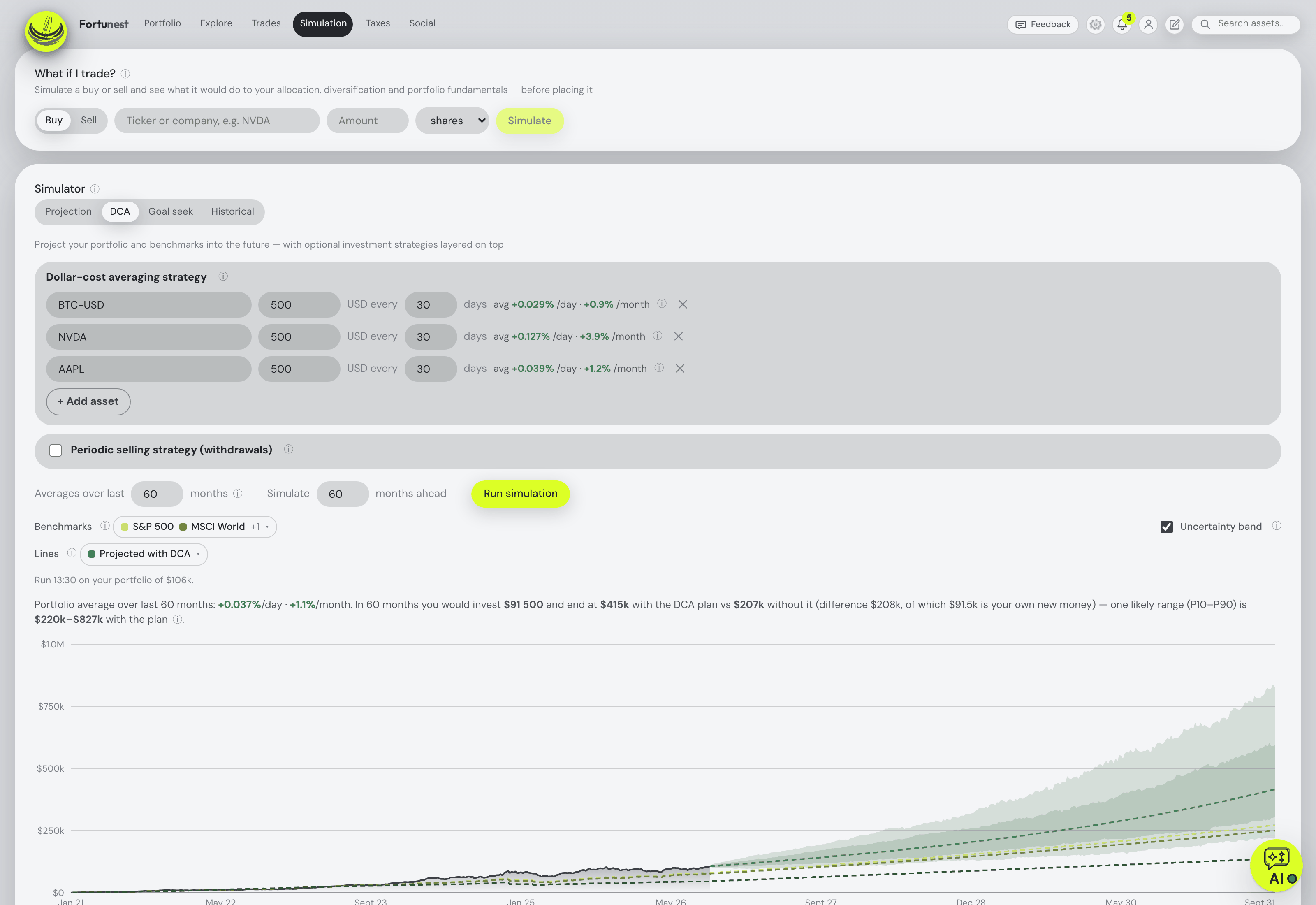
How the two differ in practice
Getting the data in. Snowball's front door is a connection: link the brokerage through Yodlee or SnapTrade and holdings are imported and synced every night, or import your broker's own activity report if it is one of the fifteen supported for that route — and note that linking starts on the paid Starter plan. Fortunest's front door is the export plus the key: twenty-nine CSV and Excel formats detected on sight, six direct API connections for Kraken, Binance, Coinbase, Coinmate, Interactive Brokers and Trading 212, twenty-two brokers through SnapTrade, a folder drop that sorts mixed files in one pass, and transfer matching so a move between your own accounts is not read as a sale and a purchase. Snowball reaches more institutions; Fortunest reaches the European brokers that never appear on an aggregator list, and the crypto exchanges alongside them.
What you get out. Snowball's analysis leans towards income and comparison: the dividend suite, diversification by sector, country, region and asset class, benchmarking against four major indices with full benchmarking on the Investor plan, a Sharpe coefficient, an advanced rebalance tool and long backtests. Fortunest leans towards return and risk: TWR beside IRR, seven benchmarks flow-matched to your deposits rather than rebased, volatility, Sharpe, Sortino, beta, correlation and drawdowns, value-weighted fundamentals, fair value from six models, a fee total per account, and the Simulation tab in the picture above — projection, DCA, goal seek and historical replay, with what-if trades applied to your real weights.
Tax, AI and the price. On tax the two barely overlap: Snowball lets you set a custom withholding tax rate on every plan, which is the right tool for dividend income, while Fortunest's Pro Taxes tab pairs each sale against the lots it consumed, applies a configurable holding-period time test, totals realised gains by year and plans a sale for the least tax — with Czech defaults and no per-country presets, so it is orientation rather than a filing. On AI there is nothing to compare: Snowball mentions none, while Fortunest's assistant reads the portfolio and the screen, explains the income and the risk numbers on your own figures, looks up any company down to its results filing, drives the dashboard, runs locally if you want it to, and on Pro answers to Claude Code or Codex over MCP — what the assistant can tell you works through the questions. On price, Fortunest's €69 a year sits below Snowball's US$79.99 entry plan and well below the US$149.99 tier where the benchmarking and the backtests live. See the Taxes chapter and the Simulation chapter.
How we compared
We read Snowball Analytics' own pricing page, product site and dividend-tracker page on 7 September 2026 and took the figures and the phrasing from there, quoting where the wording matters. Fortunest's column comes from its documentation and its plans page. Where a page says nothing about a row, the cell says "not described" — that is about the page on that date, not about the product. We build Fortunest, so we are not neutral: the table is meant to be checkable rather than impartial, both verdicts state where the product falls short, and the section above lists what Snowball does that we do not.
Questions people ask
Is Fortunest a good Snowball Analytics alternative?
For a European investor who is not primarily a dividend investor, yes. Fortunest costs 69 euros a year against Snowball's 79.99 US dollars for the first paid plan, gives you the whole dashboard and an AI assistant free without an account — one that reads your actual holdings and the screen, explains any metric on your own numbers including the income side, looks up any company's quote, news, earnings and dividend dates and the SEC filing behind them, and on Pro can be driven by Claude Code, Codex or any MCP agent — converts every day of history at that day's rate, and adds TWR and IRR, Sortino, beta, drawdowns and tax lot pairing. If the dividend calendar, the dividend rating and the thirty-year backtests are why you use Snowball, stay.
Can I import my Snowball Analytics export into Fortunest?
Not as a Snowball file. Fortunest reads broker exports rather than tracker exports — the only tracker formats it detects are Parqet, Delta and CoinTracking. Since Snowball is filled either by a nightly brokerage connection or by importing your broker's own activity report, you already have the source: download the CSV or Excel export from each broker again and drop the whole folder into Fortunest, where the format is detected per file. The list is in every supported platform.
Which is cheaper, Fortunest or Snowball Analytics?
Fortunest. Snowball's free plan is one portfolio with ten holdings, and brokerage linking, unlimited holdings and the rebalance tool start at Starter, 79.99 US dollars a year; Investor is 149.99 and Expert 249.99. Fortunest is free without an account for 50 assets across 3 accounts, including the assistant and the trade plan, and Pro is 6.99 euros a month or 69 euros a year with no asset or account limit.
Which is better for dividend investors?
Snowball, and it is not close. It was built around dividends: a calendar, dividend growth tracking, a dividend rating that scores a company's earnings, yield and payout ratio, a reinvestment calculator, custom withholding tax on every plan including the free one, and a top-fifty dividend list with filters. Fortunest shows dividends received, an events calendar and fee totals, but it does not forecast or rate a dividend stream.
Does Snowball Analytics have an AI assistant?
No AI features are mentioned on the pages we checked in September 2026. Fortunest's assistant is on the free plan, reads your actual holdings, answers with your own figures, can switch tabs, run a what-if trade or start a backtest of the trade plan, and can run entirely on a local model through Ollama or LM Studio for local inference on desktop. Cloud AI, Pro tax calculations, sharing and hosted sync have separate outbound data flows. The AI tracker guide compares the field.
Sources
- Fortunest — plans and pricing, every supported platform, the Portfolio chapter, the Simulation chapter, the Taxes chapter and the Social chapter (7 September 2026).
- Snowball Analytics — pricing, the product site and the dividend tracker page (7 September 2026).
Signals, analyses and assistant answers in Fortunest are informational — not financial or tax advice. This page compares features described on the vendors' own pages, not investment outcomes.