Guides · Fortunest facts reviewed 8 September 2026
Fortunest vs Parqet: which portfolio tracker fits you in 2026
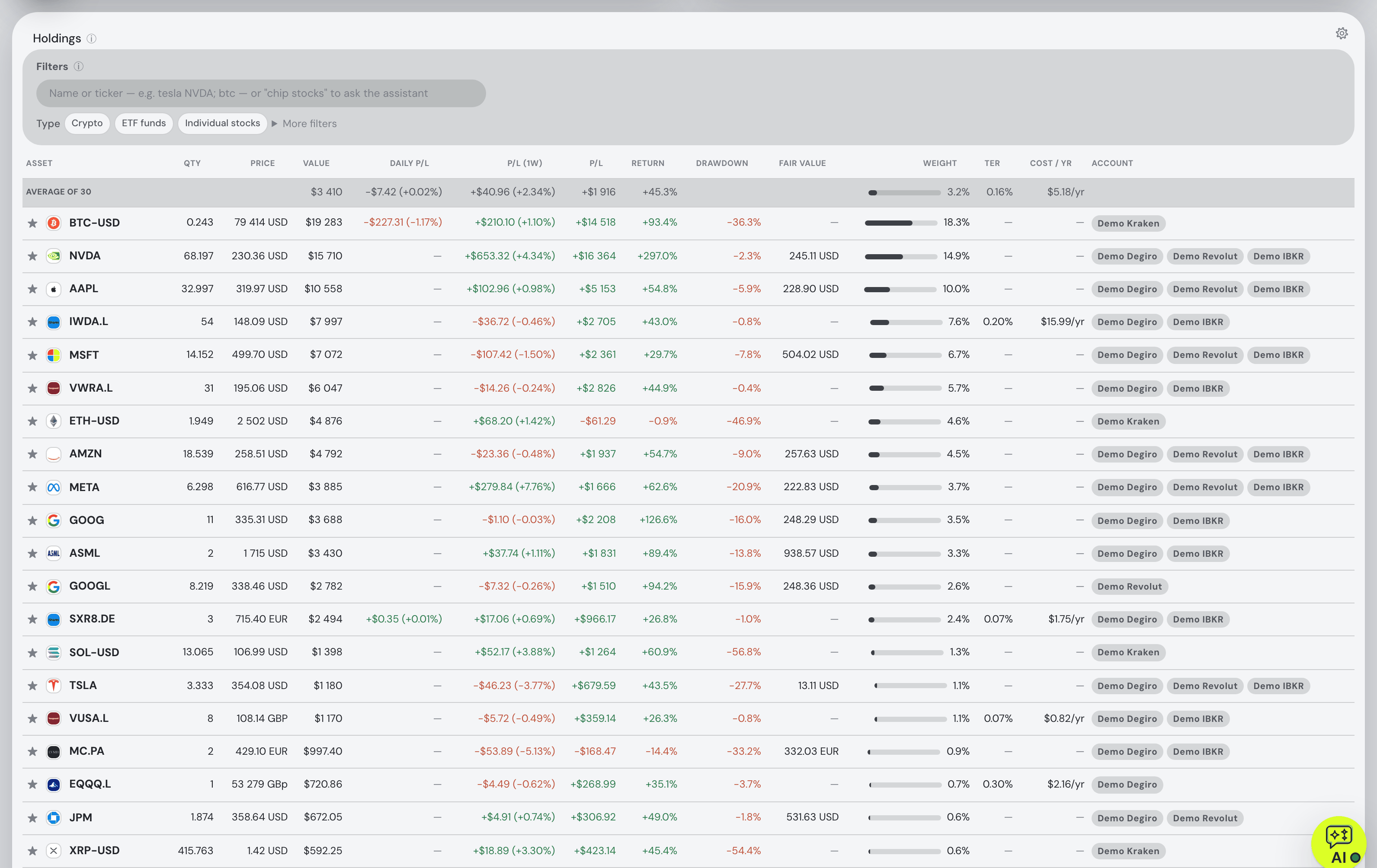
Parqet is the German-market specialist: PDF statements from more than fifty brokers, automatic sync with five German ones, and a Steuer-Dashboard on its Plus plan. Fortunest is the multi-country engine: broker exports and exchange APIs rebuilt into a daily-rate history, risk statistics and an AI assistant on the free plan that does not merely answer about your data but acts on it — it sees the screen, explains any metric on your own numbers, looks up any company's quote, news, earnings or SEC filing, runs what-ifs and adds assets on request, and on Pro exposes an MCP server so Claude Code, Codex or any MCP-capable agent can do the same with sensitive changes reviewed unless covered by an active permission. Pick Parqet if your brokers are German; pick Fortunest if they are not — or if you want the analysis, and an agent, for €69 a year.
The short answer
- Pick Fortunest if your accounts sit at several brokers and an exchange rather than at Trade Republic and Scalable: 50 supported platforms, read-only API keys for crypto, every day of history converted at that day's rate, TWR and IRR with volatility, Sharpe, Sortino, beta and drawdowns, a scored trade plan you can backtest, and an assistant that reads your holdings and the screen in front of you — explaining any metric on your own numbers, filtering the table from a sentence, looking up any company's quote, news, earnings or SEC filing, adding an asset from a sentence or a brokerage screenshot, and changing the dashboard when you ask, each action reporting ✓ or ✗ with its reason, and an Undo on data edits. All on the free plan, without an account. Pro is €69 a year and adds an MCP server for Claude Code, Codex or any MCP-capable agent.
- Pick Parqet if you are a German-speaking investor whose evidence arrives as PDF Abrechnungen: statements from 50+ brokers read automatically, zero-click sync with Trade Republic, Scalable Capital, ING, comdirect and Consorsbank, a dividend calendar over 35,000+ paying securities, an X-Ray that looks through your ETFs, and a German tax dashboard. Plus is €11.99 a month.
The comparison
Each cell is what the vendor's own pages say, in the vendor's terms, on the date in the footnote. Not described means the page does not mention it — a statement about the page, not about the product. A green ✓ marks whichever product leads a row on that row's own terms; the imports row is a genuine tie, and both are marked.
| Fortunest1 | Parqet2 | |
|---|---|---|
| Runs on |
|
|
| Account required |
|
|
| Free plan |
|
|
| Paid from |
|
|
| Broker imports for EU investors |
|
|
| Currencies |
|
|
| Returns & risk |
|
|
| Tax |
|
|
| AI assistant |
|
|
| Research & extras |
|
|
| Where your data lives |
|
|
| Open source |
|
|
Parqet's cells were checked on its own Preise & Pläne page and product site on 7 September 2026; the German quotations are Parqet's own wording. Fortunest's cells come from its documentation. Prices are list prices before promotions and, for Fortunest, before VAT. Both products ship continuously.
When to pick which
This comparison turns almost entirely on where your accounts are and what form your evidence arrives in. Seven situations, and the honest answer for each:
| Your situation | Pick | Why |
|---|---|---|
| Your broker is Trade Republic, Scalable, ING, comdirect or Consorsbank | Parqet | Those five sync automatically. Fortunest reads Trade Republic as a CSV export and has no German broker sync at all. |
| Your broker only ever sends you PDF statements | Parqet | PDF statements from 50+ brokers are parsed for you; Fortunest's importer reads CSV and Excel exports, not PDFs. |
| You hold DEGIRO plus a crypto exchange | Fortunest | DEGIRO's Transactions export and Account statement are recognised, and Binance, Coinbase, Kraken and Coinmate connect with read-only API keys. |
| You file German taxes on your investments | Parqet | The Steuer-Dashboard is a German preset. Fortunest's rulebook is configurable but ships with Czech defaults and no country presets. |
| You want an AI that answers about your holdings without paying | Fortunest | The assistant is on the free plan, sees the screen and can change the dashboard; Parqet's route is connecting ChatGPT or Claude to your account. |
| You want your own AI agent — Claude Code, Codex or any MCP client — to read and act on the portfolio | Fortunest, Pro | Pro exposes an MCP server your agent signs into, so it can read the live dashboard and act on it, with sensitive changes reviewed unless covered by an active permission and grants you can time-limit or revoke. Parqet's route is the other direction: you connect ChatGPT or Claude to your Parqet account and ask about your data. |
| You want local storage and local AI | Fortunest | The desktop app keeps the database on your disk and can run the assistant locally; Parqet is a hosted service, hosted in Germany. |
The verdicts
Fortunest — our pick, if the criterion is a portfolio spread beyond one country
Best for: accounts at several brokers and an exchange, with the analysis and an AI assistant on one screen.
Free without an account · Pro €6.99/mo or €69/yr
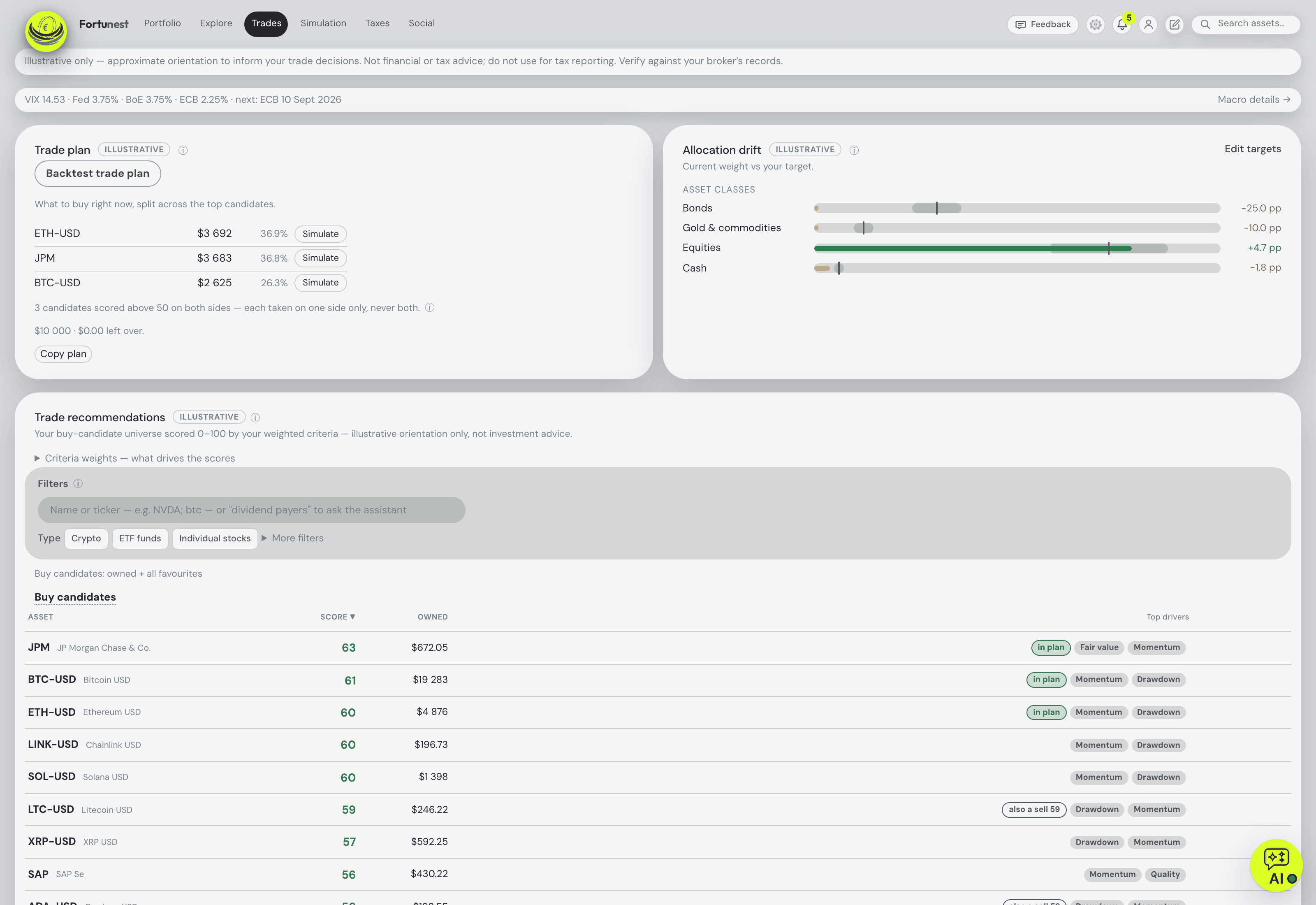
You drop the exports your brokers already give you — DEGIRO, XTB, Revolut, eToro, Trading 212, Trade Republic, Saxo and about two dozen more — connect Kraken, Binance or Coinbase with a read-only key, and the engine rebuilds one history: transfers between your own accounts matched so nothing is counted twice, every day converted at that day's rate, returns as both TWR and IRR against seven benchmarks fed your actual deposits. Risk comes as volatility, Sharpe, Sortino, beta and drawdowns, fair value from six models with every assumption shown, and the Trades tab turns scored candidates into a plan you can replay against last year.
On AI the difference is not whether there is one but where it stands. Parqet's answer is an integration: you point ChatGPT or Claude at your Parqet account and ask about your data. Fortunest's assistant is inside the app — it sees the holdings, the tab you are on, the filters you set and the simulation you just ran, so "why is this position down?" needs no further context; it explains any metric on your own numbers, looks up any company held or not down to the results filing the SEC has, and it acts: switch tabs, filter the table, run a what-if trade, launch the backtest, change a setting, add the flat you bought in 2019 or read the positions out of a brokerage screenshot, each reporting ✓ or ✗ with its reason, and an Undo on data edits. On Pro that same toolkit is published as an MCP server, so Claude Code, Codex or any MCP-capable client reads and drives one live dashboard with sensitive changes reviewed unless covered by an active permission within the connection’s existing scopes; and the in-app assistant can use Ollama or LM Studio for local inference. External-agent context goes to your chosen agent provider; the desktop MCP bridge needs a synchronized hosted portfolio.
Where it falls short: no PDF statement parsing — the importer wants the CSV or Excel export; no automatic sync with German brokers, and no bank connections; no native mobile app yet; the Taxes tab's defaults are Czech, so a German investor gets accurate lot pairing but not a German tax view; and the MCP server for external agents needs Pro.
Parqet
Best for: German-speaking investors whose brokers send PDF statements — or sync automatically.
Basis €0 · Plus €11.99/mo · Investor €29.99/mo
Parqet solved the problem German investors actually have: the evidence arrives as an Abrechnung, so Parqet reads Abrechnungen — PDFs as well as CSV exports, from more than fifty brokers — and syncs Trade Republic, Scalable Capital, ING, comdirect and Consorsbank with what it calls a zero-click import. On top sits a clean dashboard with country and sector splits, an X-Ray that looks through your ETFs to the underlying weights, a dividend calendar covering more than 35,000 paying securities with forecasts, 40-plus currencies converted to your home currency, and, on Plus, a Steuer-Dashboard for the year's taxes on sales, dividends and withholding. It states German data storage and that your data is not monetised, and has native apps on both phones.
Where it falls short: the free tier is one portfolio with two integrations and basic analysis — the X-Ray, benchmarks, forecasts and tax dashboard all begin at €11.99 a month; integrations are capped per plan; risk statistics and the currency-conversion method are not described; and the product, the community and the tax logic are German-first, which is exactly right if you are German and a limitation if you are not.
What Parqet does that Fortunest doesn't
This is the part a comparison page usually leaves out, so here it is plainly. If any of these matter to you, Parqet is the better buy:
- PDF statement import. Parqet parses broker Abrechnungen as PDFs. Fortunest's importer reads CSV and Excel exports only; a PDF-only broker means typing the trades in or attaching documents to the assistant.
- Automatic sync with five German brokers — Trade Republic, Scalable Capital, ING, comdirect and Consorsbank — with Bitpanda announced. Fortunest reads Trade Republic as a file and syncs no German broker automatically.
- A German tax dashboard covering the year's taxes on sales, dividends and withholding tax. Fortunest's rulebook can be shaped to a holding period, thresholds and a flat rate, but there are no per-country presets and nothing German out of the box.
- Native iOS and Android apps. Fortunest's web app is built for phones and installs to the Home Screen, but a native app is still in development.
- A dividend calendar with forecasts across more than 35,000 dividend-paying securities. Fortunest shows dividends received and an events calendar, and does not project a dividend stream.
- Several separate portfolios — five on Plus, fifteen on Investor — each with its own view. Fortunest organises everything as accounts inside one portfolio, with watchlists alongside.
- Parqet Terminal, a separate research product for company analysis, and a German-language product and community around it.
How the two differ in practice
Getting the data in. Parqet's importer is built around the German paper trail: PDF settlement notes and CSV exports from over fifty brokers, plus zero-click sync for five German brokers, with the number of integrations capped by plan. Fortunest's is built around exports and keys: twenty-nine CSV and Excel formats detected automatically, six direct APIs for exchanges and Interactive Brokers, twenty-two brokers through a SnapTrade sign-in, no integration cap, and a folder-drop that sorts a year of mixed files in one go. If your broker only sends PDFs, Parqet wins outright; if your broker is Czech, Polish, Nordic or a crypto exchange, Fortunest reaches it and Parqet's sync list does not.
What you get out. Parqet's analysis is allocation-led: splits by country, sector and asset type, an X-Ray that resolves ETF holdings into real weights, dividend forecasting, and benchmarks — the substantial parts from Plus upwards. Fortunest's is return- and risk-led: annualised TWR beside money-weighted IRR, volatility, Sharpe, Sortino, beta, correlation and drawdowns, seven benchmarks flow-matched to your deposits, value-weighted fundamentals, fair value from six models, fee totals per account, and the Trades tab in the picture above, which scores candidates on criteria you weight and produces a plan it can backtest month by month against what you actually did.
Tax, AI and hosting. On tax the honest answer is that they are built for different countries: Parqet's Steuer-Dashboard is German, Fortunest's rulebook defaults to the Czech time test, small-sale exemption and flat rate — every one of them a setting, so rules of that shape fit, but there is no German preset. On AI the difference is placement: Parqet connects ChatGPT or Claude to your account from the outside, Fortunest's assistant lives beside the dashboard, sees the screen, can switch tabs, run a what-if or start a backtest, and supports local inference through Ollama or LM Studio on desktop. Cloud AI, Pro tax calculations, sharing and hosted sync have separate outbound data flows. Both keep data in the EU; only Fortunest also offers a desktop app where the database is a file on your disk. See the Taxes chapter and the Assistant chapter, or what the assistant can tell you for the questions it actually answers.
How we compared
We read Parqet's own pricing page and product site on 7 September 2026 and took the figures and the phrasing from there, in German where the German is the claim. Fortunest's column comes from its documentation and its plans page. Where a page says nothing about a row, the cell says "not described" — that is about the page on that date, not about the product. We build Fortunest, so we are not neutral: the table is meant to be checkable rather than impartial, both verdicts state where the product falls short, and the section above lists what Parqet does that we do not.
Questions people ask
Is Fortunest a good Parqet alternative?
Yes, if your brokers are not the five German ones Parqet syncs and you want the analysis without paying monthly: Fortunest gives you the whole dashboard, risk statistics, a scored trade plan and an AI assistant on the free plan — one that sees the screen as well as the holdings, explains any metric on your own numbers, looks up any company's quote, news, earnings or SEC filing, and acts on the dashboard rather than only describing it, with an MCP server on Pro for Claude Code, Codex or any MCP agent — converts every day at that day's rate, and costs 69 euros a year for Pro against Parqet Plus at 11.99 euros a month. Parqet remains the better choice for a German investor who imports PDF statements and wants the German tax dashboard.
Can I import my Parqet export into Fortunest?
Yes. The Parqet export is one of the formats Fortunest detects automatically — export your activities from Parqet, drop the file in, and the history is rebuilt with transfers between your own accounts matched. It is one of only three tracker formats Fortunest reads, alongside Delta and CoinTracking; everything else comes from the brokers and exchanges themselves. The row for it is in every supported platform.
Which is cheaper, Fortunest or Parqet?
Fortunest, once you want the full analysis. Parqet's Basis plan is free with one portfolio, unlimited securities, five extra assets and two integrations, but the X-Ray, benchmarks, forecasts and tax dashboard begin at Plus, 11.99 euros a month; Investor is 29.99 euros a month. Fortunest is free without an account for 50 assets across 3 accounts including the assistant, and Pro is 6.99 euros a month or 69 euros a year.
Does Parqet handle German taxes?
Parqet's Plus plan includes a Steuer-Dashboard showing the year's taxes on sales, dividends and withholding tax, which is a genuine German preset. Fortunest's Taxes tab is one configurable rulebook whose defaults are the Czech rules — a holding-period time test, a small-sale exemption and a flat rate — with no per-country presets, so for German filing Parqet is the closer fit. Fortunest's lot pairing and realised-gains totals are accurate anywhere; the detail is in the Taxes chapter.
Which one is better for a portfolio spread across several countries?
Fortunest. It reads 29 broker exports including DEGIRO, XTB, Revolut, eToro, Trading 212 and Saxo, connects six exchanges and brokers by read-only API key and 22 more through SnapTrade, converts every day of history at that day's exchange rate into any display currency, and handles London pence listings. Parqet supports 40-plus currencies and imports statements from over 50 brokers, but its automatic sync covers five German brokers. More in the multi-currency guide.
Sources
- Fortunest — plans and pricing, every supported platform, the Portfolio chapter, the Trades chapter, the Taxes chapter and the Privacy chapter (7 September 2026).
- Parqet — Preise & Pläne and the product site (7 September 2026).
Signals, analyses and assistant answers in Fortunest are informational — not financial or tax advice. This page compares features described on the vendors' own pages, not investment outcomes.