Guides · Fortunest facts reviewed 8 September 2026
Fortunest vs Sharesight: which portfolio tracker fits you in 2026
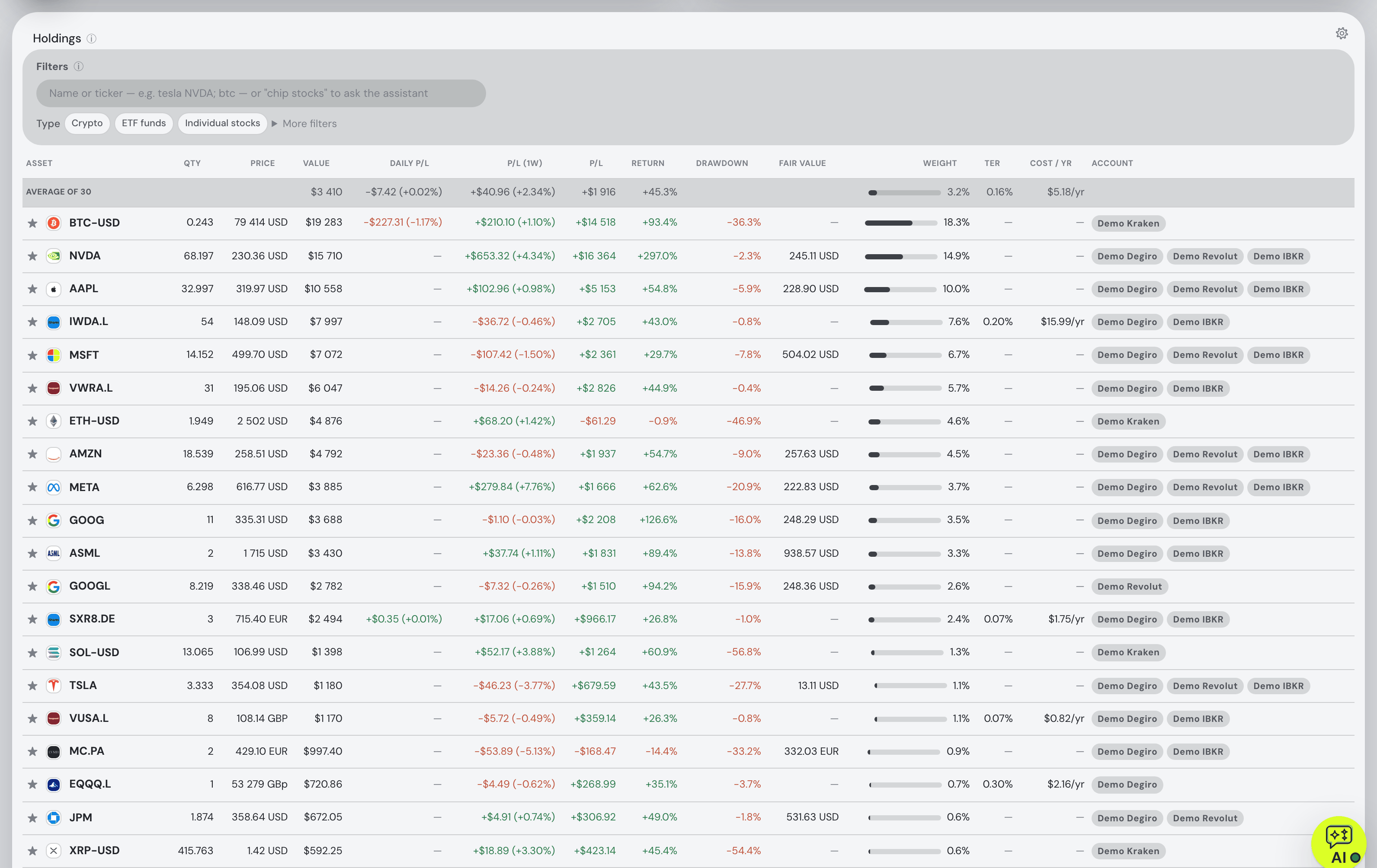
Sharesight is a reporting service: it imports from more than two hundred brokers, applies corporate actions automatically, and writes the tax and performance reports an accountant asks for. Fortunest is a dashboard with an engine behind it: the same imports as files plus API keys, risk statistics, fair value, a trade plan and an AI assistant that reads the actual portfolio — it explains any metric on your own numbers, walks you through which lots have passed the holding-period test, looks up any company's quote, news, earnings or SEC filing, and on Pro hands the same tools to Claude Code, Codex or any MCP-capable agent. Pick Sharesight for the paperwork; pick Fortunest for the analysis, at a fifth of the price.
The short answer
- Pick Fortunest if you want the whole dashboard without a holdings cap: annualised TWR and IRR, volatility, Sharpe, Sortino, beta and drawdowns, seven flow-matched benchmarks, fair-value estimates, a scored trade plan and an AI assistant that answers about your own portfolio — it reads the holdings and the live screen, explains any metric on your numbers, explains your tax lots and the next time-test maturity on Pro, looks up any company's quote, news, earnings or SEC filing, and adds an asset from a sentence or a brokerage screenshot. Free without an account; €69 a year for Pro, which also opens the same tools to Claude Code, Codex or any MCP-capable agent; and a desktop app that keeps everything on your disk.
- Pick Sharesight if your tracker's job is to produce documents: taxable income, sold securities and all-trades reports with the tax year set to your country's financial year, automatic dividends and corporate actions from 200+ brokers across 60+ markets, and a portfolio you can share with an accountant. Unlimited holdings start at US$18 a month billed annually.
The comparison
Each cell is what the vendor's own pages say, in the vendor's terms, on the date in the footnote. Not described means the page does not mention it — a statement about the page, not about the product. A green ✓ marks whichever product leads a row on that row's own terms.
| Fortunest1 | Sharesight2 | |
|---|---|---|
| Runs on |
|
|
| Account required |
|
|
| Free plan |
|
|
| Paid from |
|
|
| Broker imports for EU investors |
|
|
| Currencies |
|
|
| Returns & risk |
|
|
| Tax |
|
|
| AI assistant |
|
|
| Sharing & community |
|
|
| Where your data lives |
|
|
| Open source |
|
|
Sharesight's cells were checked on its own pricing, features, EU tax, broker-partners and privacy pages on 7 September 2026; the capital-gains calculator and the "200+ brokers" figure were also on our landing-page comparison of 19 August 2026. Fortunest's cells come from its documentation. Prices are list prices before promotions and, for Fortunest, before VAT; Sharesight's are in US dollars, Fortunest's in euros.
When to pick which
The choice is rarely close once you name what the tracker is for. Seven situations, and the honest answer for each:
| Your situation | Pick | Why |
|---|---|---|
| Your accountant asks for a capital-gains report every spring | Sharesight | Its sold-securities and taxable-income reports are built for exactly that, with the tax year set to your country's financial year. |
| You hold DEGIRO plus a crypto exchange | Fortunest | DEGIRO is a CSV for both, and Fortunest adds read-only keys for Binance, Coinbase, Kraken and Coinmate; Sharesight's strength is listed equities and funds. |
| You have more than ten holdings and do not want to pay yet | Fortunest | The free plan runs to 50 assets across 3 accounts with the whole dashboard; Sharesight's free tier stops at 10 holdings and has no tax reports. |
| You want the most broker connections that need no files | Sharesight | 200+ brokers imported automatically, across 60+ markets — more automation than Fortunest's 28 automatic connections. |
| You want Sharpe, Sortino, beta and a benchmark matched to your deposits | Fortunest | Sharesight's pages describe performance and diversity reports; risk statistics and benchmarks are not described there. |
| You want your own AI agent — Claude Code, Codex or any MCP client — to read and act on the portfolio | Fortunest, Pro | Pro exposes an MCP server your agent signs into, so it can read the live dashboard and act on it, with sensitive changes reviewed unless covered by an active permission. Sharesight describes no assistant and no agent connection — only Claude as a statement converter behind the scenes. |
| You would rather your history did not sit in the United States | Fortunest | The desktop app keeps everything on your own disk; Sharesight's policy states storage in the US and lists advertising and analytics recipients. |
The verdicts
Fortunest — our pick, if the criterion is analysis per euro
Best for: European investors who want the numbers, the AI and no holdings cap, at €69 a year.
Free without an account · Pro €6.99/mo or €69/yr
You drop the CSV exports your brokers already give you, connect the exchanges with read-only keys, and the engine rebuilds one history: transfers between your own accounts matched so nothing is counted twice, every day converted at that day's rate, returns as both annualised TWR and money-weighted IRR, seven benchmarks fed the same deposits you made. Then come the parts Sharesight does not describe — volatility, Sharpe, Sortino, beta, correlation and drawdowns, fair value from six models with every assumption shown, a fee total per account, a scored trade plan you can backtest, and an assistant that answers about your holdings and drives the dashboard when you ask.
That assistant is the row where the two products are least alike. Sharesight's own privacy policy names Claude as a processor that converts statements into a standard format — useful plumbing, but not something you can ask a question. Fortunest's reads the holdings and the live screen, so it explains any metric on your own numbers, filters the holdings table from a sentence, looks up any company held or not — quote, ratios, analyst target, news, next earnings and dividend dates, and the company's own results filing from the SEC — and, on Pro, reads your tax lots back to you: what is already past the time test, what matures next, what a planned sale would cost in tax. It also acts: run a what-if trade, start a backtest, change a setting, add an asset from a sentence or a brokerage screenshot, each reporting ✓ or ✗ with its reason, and an Undo on data edits. On Pro the same tools are exposed over MCP, so Claude Code, Codex or any MCP-capable client can read and drive the dashboard with sensitive changes reviewed unless covered by an active permission; and the in-app assistant can use Ollama or LM Studio for local inference. External-agent context goes to your chosen agent provider; the desktop MCP bridge needs a synchronized hosted portfolio.
Where it falls short: no native mobile app yet; the Taxes tab is one configurable rulebook with Czech defaults and no per-country presets, so it is orientation rather than a report your accountant will recognise; alerts beyond the portfolio brief are a Pro feature, where Sharesight includes price alerts free; 28 automatic connections is far fewer than 200+; and the MCP server for external agents needs Pro as well.
What Sharesight does that Fortunest doesn't
This is the part a comparison page usually leaves out, so here it is plainly. If any of these matter to you, Sharesight is the better buy:
- Automatic imports from 200+ brokers, including the US, UK, Australian and New Zealand brokers Fortunest cannot reach at all, plus trade-confirmation email imports on every plan — forward the contract note and the trade appears.
- Corporate actions applied for you. "Dividends, DRPs and share splits are automatically updated." Fortunest is split-correct and shows dividends received, but dividend reinvestment plans are not described in its documentation.
- Tax reports in the shape a professional expects — taxable income, sold securities, all trades, with the tax year set to your country's financial year. Fortunest's Taxes tab pairs lots and applies a holding-period test against one configurable rulebook whose defaults are the Czech rules; there are no per-country presets and it is explicitly orientation, not a filing.
- Sharing with an accountant or adviser as a first-class feature, on the free plan too. Fortunest's sharing is a social feed of relative figures between friends.
- Price and portfolio email alerts on the free plan. In Fortunest, insights and the portfolio brief are free but every alert type is a Pro feature.
- Property, cash accounts and precious metals as tracked types with their own handling. Fortunest covers these as manual or custom assets with a value you maintain.
- 60+ markets and 700,000+ instruments stated on its features page, a wider net than a European-focused import list.
How the two differ in practice
Getting the data in. Sharesight's model is automation: pick your broker from a list of more than two hundred, connect it or forward the confirmation emails, and trades keep arriving. Fortunest's is a mixture: six exchanges and brokers connect through read-only API keys, twenty-two more through a SnapTrade sign-in, and twenty-nine platforms arrive as the CSV or Excel export the broker already gives you — DEGIRO's Transactions file, XTB's statement, Revolut's, Trade Republic's, Saxo's. You can drop a whole folder at once and the format is detected per file; transfers between your own accounts are matched so a move from one broker to another is not counted as a purchase and a sale. Sharesight is less work per month; Fortunest reaches European brokers and crypto exchanges that no automatic list covers.
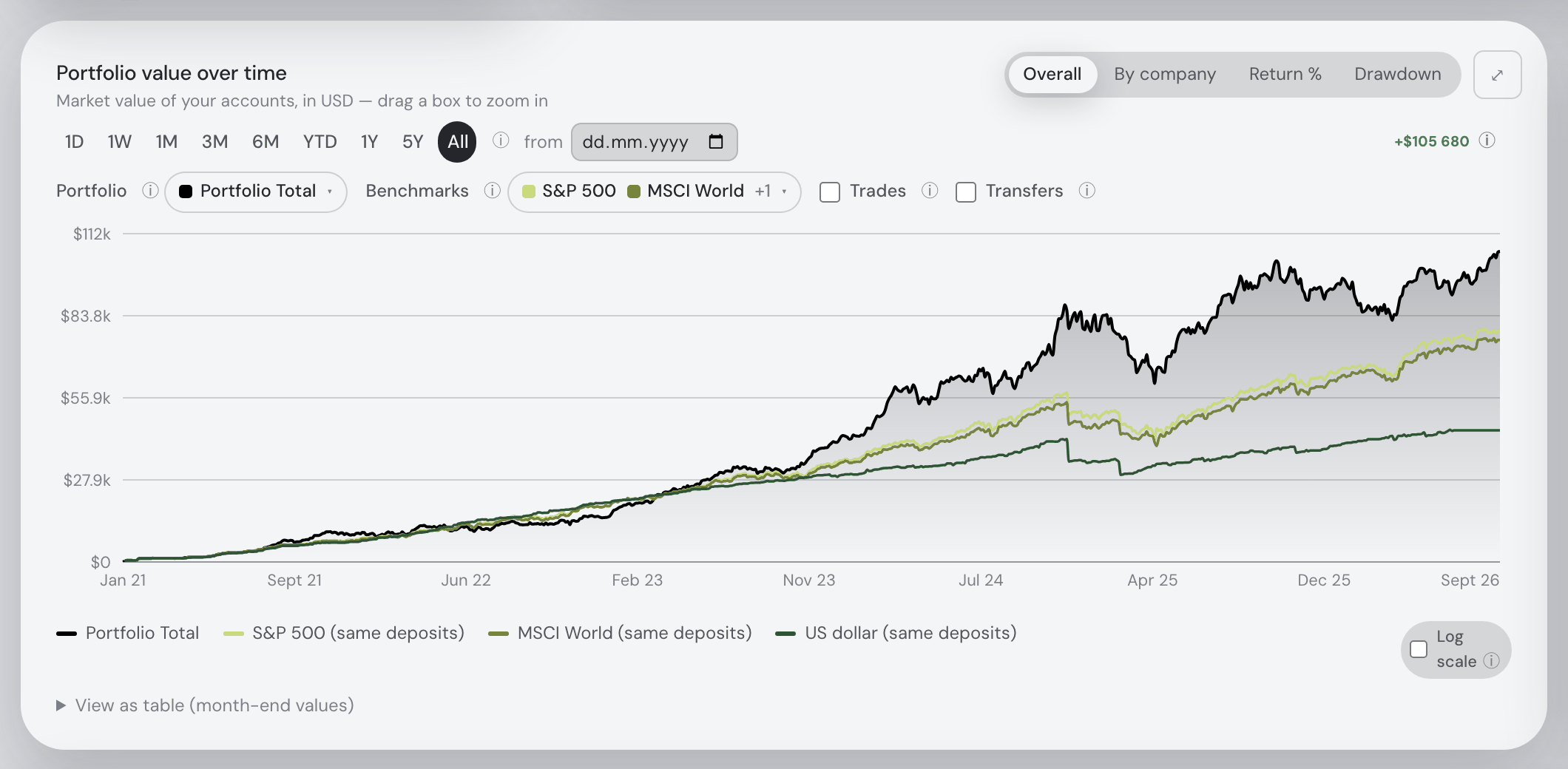
What you get out. Sharesight answers "what happened, and what do I owe": performance and diversity reports, dividends and corporate actions applied automatically, and the tax reports that are the reason most people pay for it. Fortunest answers "where do I stand, and what should I consider": TWR beside IRR, risk as volatility, Sharpe, Sortino, beta, correlation and drawdowns, seven flow-matched benchmarks on the chart above, value-weighted fundamentals, six fair-value models with the gap to price, a fee total per account, and a Trades tab that scores candidates on fifteen criteria you weight yourself and turns them into a plan you can backtest against the last year. Beside all of it sits an assistant that reads the same figures: ask what your Sortino ratio is telling you, which lots go tax-free next spring, or what a company reported last quarter, and the answer comes from your own numbers and the filing itself — what the assistant can tell you works through the list, and the Assistant chapter sets out what it may and may not do.
Price, and where it all sits. The cost gap is the blunt part of this comparison: a portfolio of forty holdings needs Sharesight's Standard plan at US$18 a month billed annually, while Fortunest's Pro is €69 a year and its free plan already covers fifty assets. The privacy gap is the other one. Sharesight's policy states personal information is stored in the United States and lists Google Analytics, Mixpanel, Google Ads and the Meta Pixel among its disclosures; Fortunest is built in the EU, uses cookieless analytics with no ads, and its desktop app keeps the whole database on your own machine — see the Privacy chapter and the privacy-first guide.
How we compared
We read Sharesight's own pricing, features, European tax-reporting, broker-partner and privacy pages on 7 September 2026 and took the figures and the phrasing from there, quoting where the wording matters. Fortunest's column comes from its documentation and its plans page. Where a page says nothing about a row, the cell says "not described" — that is about the page on that date, not about the product. We build Fortunest, so we are not neutral: the table is meant to be checkable rather than impartial, both verdicts state where the product falls short, and the section above lists what Sharesight does that we do not.
Questions people ask
Is Fortunest a good Sharesight alternative?
For a European investor who wants analysis rather than filing paperwork, yes. Fortunest has no holdings limit worth worrying about on Pro, costs 69 euros a year against 216 US dollars a year for Sharesight's first unlimited-holdings plan, adds risk statistics and an assistant Sharesight does not describe — one that reads your actual holdings, explains any metric and your tax lots on your own numbers, looks up any company's quote, news, earnings or SEC filing, and on Pro can be driven by Claude Code, Codex or any MCP agent — and can keep everything on your own disk in the desktop app. If what you actually buy Sharesight for is the tax report your accountant asks for, keep Sharesight.
Can I import my Sharesight export into Fortunest?
You can export your trades from Sharesight as a CSV with its All Trades report, but Fortunest reads broker exports rather than tracker exports: the only tracker formats it detects are Parqet, Delta and CoinTracking. The reliable move is to download the CSV or Excel export from each broker again — DEGIRO, XTB, Trading 212, Revolut, Saxo, Trade Republic and about two dozen more are recognised automatically — or to add older positions by hand or through the assistant. See every supported platform.
Which is cheaper, Fortunest or Sharesight?
Fortunest, at any portfolio size above ten holdings. Sharesight is free to 10 holdings with no tax reports, 7 US dollars a month billed annually to 30 holdings, and 18 US dollars a month billed annually for unlimited holdings — about 216 US dollars a year. Fortunest is free without an account for 50 assets across 3 accounts, and Pro is 6.99 euros a month or 69 euros a year with no asset or account limit.
Does Sharesight have an AI assistant?
Not a portfolio assistant you can ask questions. Sharesight's privacy policy lists Claude as a processor for AI-assisted conversion of investment statements and trade data into standardised formats, which is an importer rather than an analyst. Fortunest's assistant reads your holdings, answers with your own figures, can drive the dashboard, and runs on the free plan or entirely on a local model. The AI tracker guide compares the wider field.
Where does Sharesight store my data?
Its privacy policy states that personal information is stored in the United States, and lists the third parties it discloses data to, including Google Analytics, Mixpanel, Google Ads and the Meta Pixel, with AWS as the database host and Claude as a US processor for statement conversion. Fortunest keeps guest data in a private server session with a browser mirror, and its desktop app stores the portfolio on your disk; cloud AI, Pro tax calculations, sharing and hosted sync send their selected inputs.
Sources
- Fortunest — plans and pricing, every supported platform, the Portfolio chapter, the Taxes chapter, the Assistant chapter and the Privacy chapter (7 September 2026).
- Sharesight — pricing, features, tax reporting for European investors, brokers and apps and the privacy policy (7 September 2026).
Signals, analyses and assistant answers in Fortunest are informational — not financial or tax advice. This page compares features described on the vendors' own pages, not investment outcomes.