Guides · Fortunest facts reviewed 8 September 2026
Fortunest vs Ghostfolio: which portfolio tracker fits you in 2026
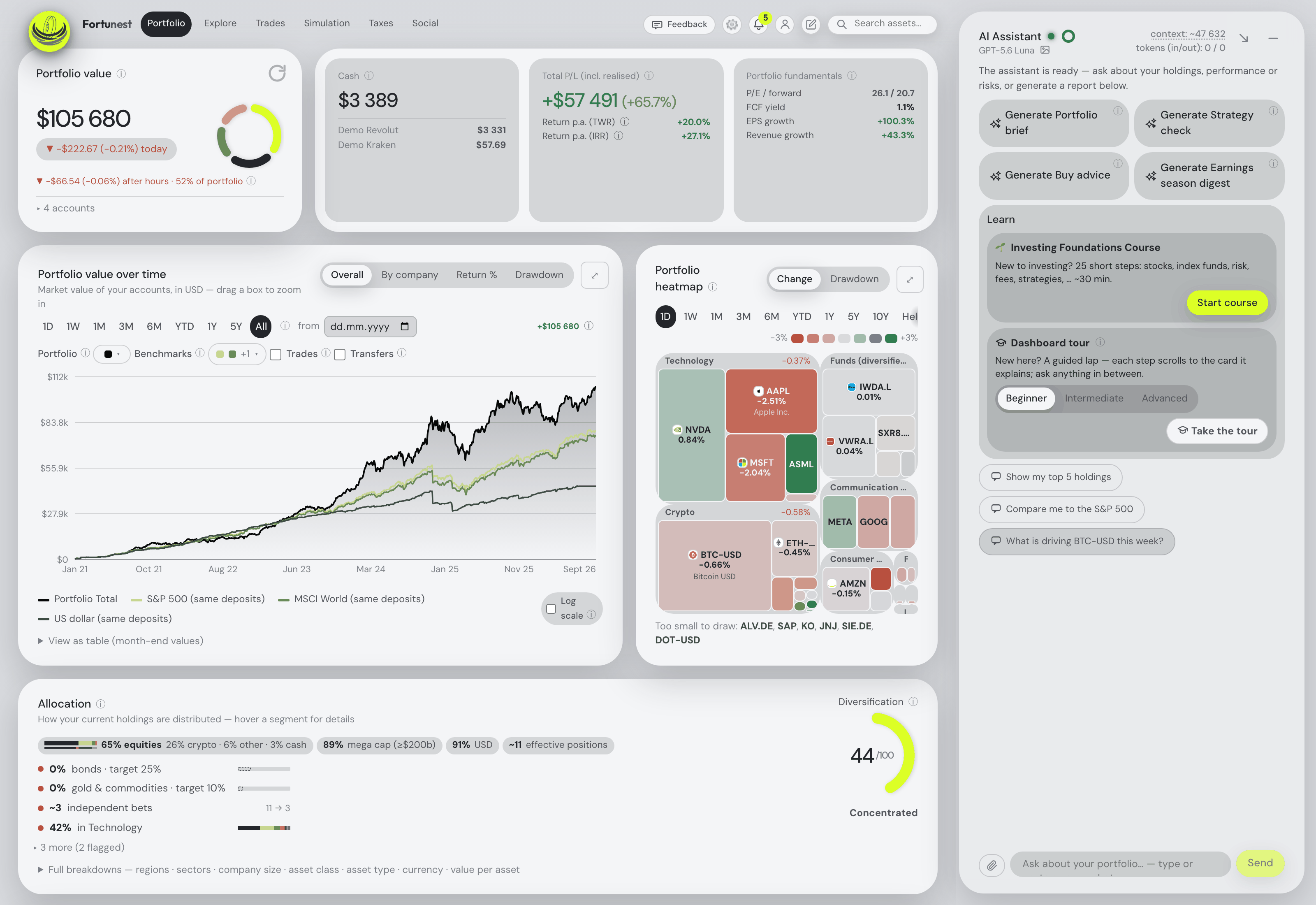
Ghostfolio is open-source wealth management you run yourself: AGPL-3.0, official Docker images, an anonymous token instead of an email, and an API you push your trades into. Fortunest is the tracker that fills itself in: 50 supported platforms, a daily-rate history, risk and tax analysis, and an AI assistant beside every tab that reads the actual portfolio — explaining any metric on your own numbers, filtering the holdings table from a sentence, looking up any company's quote, news, earnings or SEC filing, and entering the assets you describe to it. It runs on a local model through Ollama or LM Studio, and on Pro it publishes an MCP server that Claude Code, Codex or any MCP-capable agent can drive. Pick Ghostfolio if you want to own the server; pick Fortunest if you want the imports, the analysis and an agent done for you.
The short answer
- Pick Fortunest if the data entry is what puts you off: 29 broker CSV and Excel exports detected automatically, six read-only API connections including Kraken, Binance, Coinbase and Interactive Brokers, 22 brokers through SnapTrade, transfers matched, every day converted at that day's rate — then TWR and IRR, volatility, Sharpe, Sortino, beta and drawdowns, tax lots on Pro, and an assistant on the free plan that reads the holdings and the live screen, explains any metric on your own numbers, filters the table from a sentence, looks up any company's quote, news, earnings or SEC filing, and adds an asset you describe or screenshot. Pro is €69 a year and adds an MCP server, so Claude Code, Codex or any MCP-capable agent can read and drive the dashboard.
- Pick Ghostfolio if the server should be yours: AGPL-3.0 source you can audit, container images for amd64 and ARM that run on a home server or a Raspberry Pi, unlimited transactions and accounts even self-hosted, an anonymous-token sign-in with no email, a REST API for your own scripts, and a one-time yearly payment for cloud Premium rather than a subscription.
The comparison
Each cell is what the vendor's own pages say, in the vendor's terms, on the date in the footnote. Not described means the page does not mention it — a statement about the page, not about the product. A green ✓ marks whichever product leads a row on that row's own terms; five of the twelve rows below go to Ghostfolio, and one is a tie.
| Fortunest1 | Ghostfolio2 | |
|---|---|---|
| Runs on |
|
|
| Account required |
|
|
| Free plan |
|
|
| Paid from |
|
|
| Broker imports for EU investors |
|
|
| Currencies |
|
|
| Returns & risk |
|
|
| Tax |
|
|
| AI assistant |
|
|
| Extras & community |
|
|
| Where your data lives |
|
|
| Open source |
|
|
Ghostfolio's cells were checked on its source repository and its pricing page on 7 September 2026; the anonymous-token sign-in, the copy-out prompt and the US$48 Premium figure come from our landing-page comparison of 19 August 2026. Fortunest's cells come from its documentation. Prices are list prices and, for Fortunest, before VAT.
When to pick which
The dividing line is who runs the software and who does the typing. Seven situations, and the honest answer for each:
| Your situation | Pick | Why |
|---|---|---|
| You already run a home server or a NAS | Ghostfolio | Official container images for amd64 and ARM, and one-click packages for Umbrel, Unraid, CasaOS and Home Assistant. Fortunest cannot be self-hosted. |
| You want the source of the thing that computes your return | Ghostfolio | AGPL-3.0, auditable and forkable. Fortunest is closed source, though the desktop app keeps the data on your machine. |
| You hold DEGIRO plus a crypto exchange | Fortunest | The DEGIRO export is detected and Kraken, Binance, Coinbase and Coinmate connect with read-only keys; Ghostfolio has no broker or exchange connections at all. |
| You want Sharpe, Sortino, beta and flow-matched benchmarks | Fortunest | Ghostfolio reports ROAI and a static risk analysis, and puts benchmarks behind Premium. |
| You want an assistant that reads the portfolio and can act | Fortunest | Built into every tab on the free plan, able to switch tabs, run a what-if or start a backtest, and able to run on a local model. |
| You want your own AI agent — Claude Code, Codex or any MCP client — to read and act on the portfolio | Fortunest, Pro | Pro exposes an MCP server your agent signs into, so it can read the live dashboard and act on it with the assistant's own tools, sensitive changes reviewed unless covered by an active permission. Ghostfolio has a REST API to script against, but describes no agent interface and no in-app assistant. |
| You want a portfolio API to script against | Ghostfolio | A documented REST API for activities. Fortunest exposes the dashboard to Claude Code and Codex over MCP on Pro, which is an agent route, not a public API. |
The verdicts
Fortunest — our pick, if the criterion is what arrives without typing
Best for: investors who want the imports, the risk numbers and an AI assistant without running anything.
Free without an account · Pro €6.99/mo or €69/yr
Ghostfolio's honest limitation is the one Fortunest was built around: every trade has to reach it somehow, and there is no broker on the other end. Fortunest reads the exports your brokers already produce, detects the format per file, matches transfers between your own accounts, and keeps six exchanges and brokers current through read-only API keys. On top of that history it puts annualised TWR beside money-weighted IRR, volatility, Sharpe, Sortino, beta, correlation and drawdowns, seven benchmarks fed your actual deposits, fair value from six models, a scored trade plan you can backtest, tax lot pairing on Pro, and an assistant that answers with your own figures.
Ghostfolio's AI, at our last check, was a prompt you copy into a chatbot of your own; Fortunest's is wired into the app. It reads the holdings and the live screen, so it explains any metric on your own numbers, filters the holdings table from a sentence, looks up any company held or not — quote, ratios, analyst target, news, next earnings and dividend dates, and the company's own results filing from the SEC — and it acts: switch tabs, run a what-if trade, launch the trade-plan backtest, change a setting, add the flat you bought in 2019 or read the positions out of a brokerage screenshot, each reporting ✓ or ✗ with its reason, and an Undo on data edits. For anyone who came to Ghostfolio for the API, the closest equivalent here is Pro's MCP server: Claude Code, Codex or any MCP-capable client signs in and drives one live dashboard with the assistant's own tools, with sensitive changes reviewed unless covered by an active permission you can revoke. The in-app assistant can use Ollama or LM Studio for local inference. External-agent context goes to your chosen agent provider; the desktop MCP bridge needs a synchronized hosted portfolio.
Where it falls short: it is not open source and cannot be self-hosted — there is no image to put on your NAS; there is no public REST API, only MCP access for Claude Code and Codex on Pro; the free plan caps you at three accounts and fifty assets where self-hosted Ghostfolio caps nothing; and the Taxes tab's defaults are Czech with no per-country presets.
Ghostfolio
Best for: self-hosting on your own hardware, with the source in front of you.
Self-hosted free — AGPL-3.0 · Cloud Basic free · Premium a one-time yearly payment
Ghostfolio is what open-source wealth tracking should look like: official container images for amd64, ARMv7 and ARM64 and packages for the usual home-server platforms, unlimited transactions and unlimited accounts when you host it, an anonymous token instead of an email address, and a REST API that takes activities with a currency, a data source, a date, a fee, a quantity, a symbol, a type and a unit price. The interface is a progressive web app with a mobile-first design, dark mode and a zen mode, and the managed cloud has a genuinely usable free Basic tier; Premium adds the portfolio summary, allocations, performance benchmarks, a FIRE calculator and a professional data provider, as a one-time payment per year with no auto-renewal.
Where it falls short: no broker or exchange connections whatsoever, so every trade arrives by file or API call; the return measure is ROAI with a static risk analysis rather than TWR, IRR and the classic risk statistics; benchmarks and the FIRE calculator sit behind Premium; tax is not described; and there is no assistant in the app — on our August check, only a prompt you copy out into a chatbot of your own.
What Ghostfolio does that Fortunest doesn't
This is the part a comparison page usually leaves out, so here it is plainly. If any of these matter to you, Ghostfolio is the better choice — and it costs nothing to try:
- It is open source under AGPL-3.0. You can read exactly how your return is computed, change it, and keep running your fork. Fortunest is closed source.
- You can self-host it. Official Docker images for linux/amd64, arm/v7 and arm64, plus CasaOS, Home Assistant, Runtipi, TrueCharts, Umbrel and Unraid packages — a Raspberry Pi is enough. Fortunest offers a local desktop app, but no server you can run.
- An anonymous-token account. No email, no name. Fortunest's guest mode needs no account either, but an account, when you make one, is an email address.
- A REST API for activities, so scripts and other tools can write into it. Fortunest's programmatic route is MCP for Claude Code and Codex on Pro, which is an agent connection rather than an open API.
- No caps when self-hosted — unlimited transactions and unlimited accounts, free, forever. Fortunest's free plan stops at three accounts and fifty assets.
- A one-time payment for cloud Premium, explicitly "no auto-renewal", instead of a recurring subscription.
- Zen Mode, which hides the numbers when you would rather not look at them, and a mobile-first PWA that installs cleanly on a phone.
How the two differ in practice
Getting the data in. This is the widest gap between them. Ghostfolio accepts CSV and JSON files and takes activities through its REST API, with data sources of CoinGecko, Yahoo, its own, or manual — there are no broker connections, so the history is whatever you feed it, and keeping it current is a monthly chore or a script you write. Fortunest's importer detects twenty-nine broker and exchange formats on sight, so you can drop a folder of exports from DEGIRO, XTB, Revolut, Trading 212, Trade Republic and Saxo in one go; six platforms including Kraken, Binance, Coinbase and Interactive Brokers stay current through read-only keys; twenty-two more brokers sign in through SnapTrade. Transfers between your own accounts are matched so a move between brokers is not read as a sale and a purchase, and any file that fails keeps its name and reason with a retry.
What you get out. Ghostfolio reports Return on Average Investment with a set of charts and a static analysis that flags cluster risks, and puts performance benchmarks and the FIRE calculator on Premium. Fortunest computes annualised TWR and money-weighted IRR side by side, converts every historical day at that day's exchange rate, matches seven benchmarks to your own deposits, and reports volatility, Sharpe, Sortino, beta, correlation and drawdowns; beyond that sit six fair-value models with the gap to price, value-weighted fundamentals, a fee total per account, the Explore market lists, a simulator with projection, DCA, goal-seek and historical modes, and the Trades tab, which scores candidates on fifteen criteria you weight yourself and turns them into a plan it can replay against the last year.
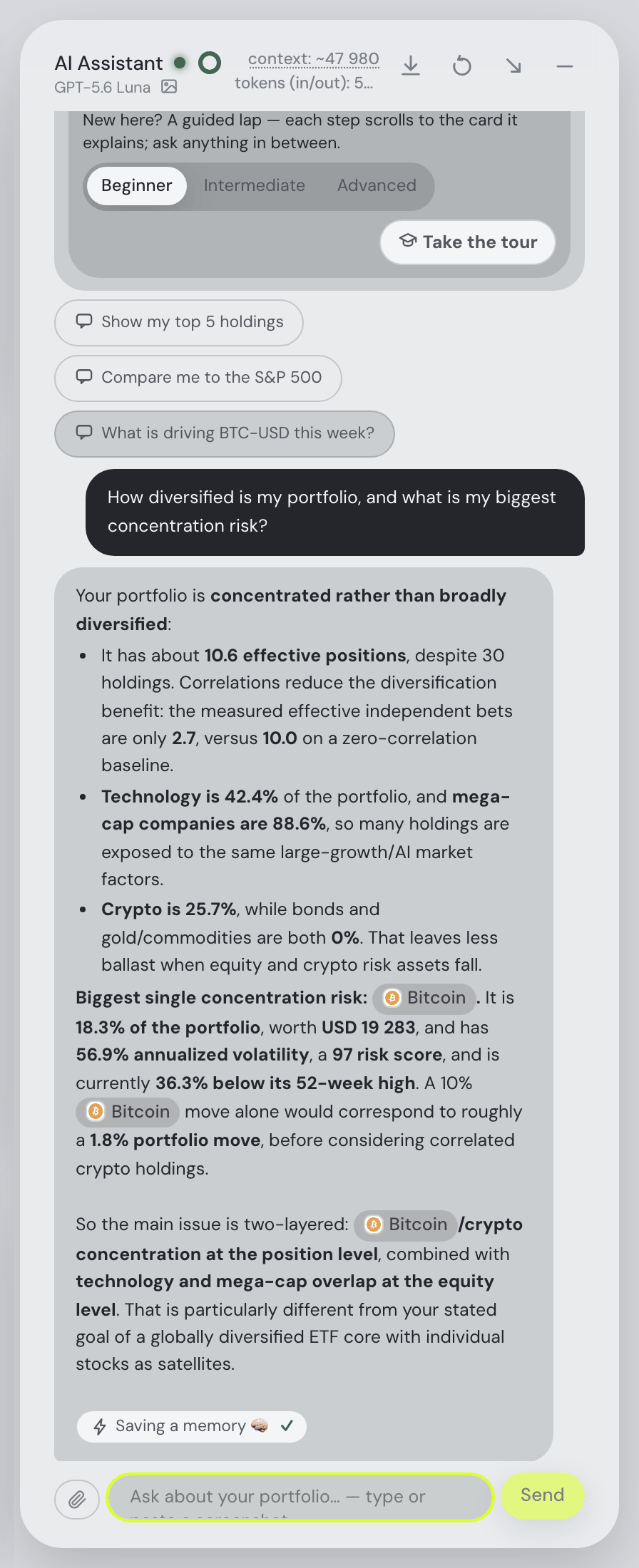
The assistant, and where things sit. Ghostfolio's answer to AI, at our last check, was a prompt you copy into your own chatbot — you paste, it guesses. Fortunest's assistant is part of the app: it sees the holdings and the current screen, answers with your figures as in the capture beside this paragraph, and will switch tabs, edit an asset, run a what-if trade, launch the trade-plan backtest or change a setting when you ask. On privacy the two converge from opposite directions: Ghostfolio is private because you host it; Fortunest is private in its desktop app, where the engine runs locally, the database is a SQLite file on your disk, the in-app assistant can use Ollama or LM Studio for local inference, and cloud AI, Pro tax calculations, sharing and hosted sync have separate outbound data flows. On Pro the same tools are published as an MCP server, so Claude Code, Codex or any MCP-capable client can read and drive the dashboard with sensitive changes reviewed unless covered by an active permission — the agent-shaped answer to Ghostfolio's REST API, though it is not a public API and it is not free. Read the Assistant chapter and the Privacy chapter, what the assistant can tell you for the questions it answers, or the privacy-first guide for the field.
How we compared
We read Ghostfolio's source repository and its pricing page on 7 September 2026 and took the feature list, the licence, the container targets and the plan structure from there; the anonymous-token sign-in, the copy-out prompt and the Premium price come from our 19 August 2026 check, because the pricing page renders its prices dynamically and we would rather quote a dated figure than guess. Fortunest's column comes from its documentation and its plans page. Where a page says nothing about a row, the cell says "not described" — that is about the page on that date, not about the product, and an open-source project may well do something its README omits. We build Fortunest, so we are not neutral: both verdicts state where the product falls short, and the section above lists what Ghostfolio does that we do not.
Questions people ask
Is Fortunest a good Ghostfolio alternative?
Yes, if you are tired of feeding it. Ghostfolio has no broker connections at all — every trade arrives as CSV, JSON or an API call — while Fortunest detects 29 broker exports, connects six exchanges and brokers by read-only key and 22 more through SnapTrade, and adds TWR and IRR, risk statistics, tax lots and an AI assistant that reads your actual holdings and the screen, explains any metric on your own numbers, looks up any company's quote, news, earnings or SEC filing, and on Pro can be driven by Claude Code, Codex or any MCP agent. It is not an alternative if self-hosting is the point: Fortunest is not open source and cannot be run on your own server.
Can I import my Ghostfolio export into Fortunest?
Not as a Ghostfolio file. Ghostfolio exports its activities as JSON and CSV, but Fortunest reads broker exports rather than tracker exports — the only tracker formats it detects are Parqet, Delta and CoinTracking. Download the CSV or Excel export from each broker again and drop the folder in; the format is detected per file and transfers between your own accounts are matched. The list is in every supported platform.
Is Ghostfolio free?
Self-hosted, yes and completely: it is licensed under AGPL-3.0, with official container images, unlimited transactions and unlimited accounts. Its managed cloud has a free Basic tier with transactions, accounts, portfolio performance and import and export, while Premium — which adds the portfolio summary, allocations, performance benchmarks, the FIRE calculator and a professional data provider — is a one-time payment per year with no auto-renewal, from 48 US dollars a year on our August check. More free options in the free trackers guide.
Does Ghostfolio have an AI assistant?
Not inside the app. On our August check it offered an experimental prompt you copy out into a chatbot of your own, which is a different thing from an assistant that reads the portfolio. Fortunest's assistant is built into every tab, sees your holdings and the screen, can switch tabs, run a what-if trade or start a backtest, is on the free plan, and can run entirely on a local model through Ollama or LM Studio. The AI tracker guide compares the field.
Which one is more private, Ghostfolio or Fortunest?
Self-hosted Ghostfolio, if you run the server: the data sits on hardware you control and you can sign in with an anonymous token rather than an email. Fortunest's equivalent is the desktop app, where the engine runs locally, the database is a SQLite file on your disk and market requests fetch quotes by ticker; cloud AI, Pro tax calculations, sharing and hosted sync send their selected inputs. On the hosted side, Fortunest lets you use the Free dashboard as a guest within its account and asset limits. Details in the Privacy chapter.
Sources
- Fortunest — plans and pricing, every supported platform, the Portfolio chapter, the Assistant chapter, the Taxes chapter and the Privacy chapter (7 September 2026).
- Ghostfolio — the source repository and README and the pricing page (7 September 2026); anonymous-token sign-in, the copy-out AI prompt and the US$48 Premium price from our landing-page comparison, checked 19 August 2026.
Signals, analyses and assistant answers in Fortunest are informational — not financial or tax advice. This page compares features described on the vendors' own pages, not investment outcomes.